
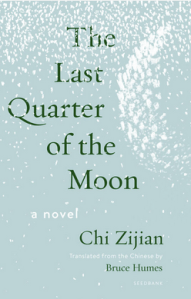
 More than a decade after my translation of the classic tale of the nomadic, reindeer-herding Evenki of northeast China, Last Quarter of the Moon (额尔古纳河右岸, 迟子建 著), Milkweed Editions — an independent, non-profit literary publisher — is launching a special edition targeting N America in January 2026.
Previously published by Harvill Secker in the UK, and Vintage Books (a Penguin imprint), for the first time this newly edited version features an Introduction by Diane Wilson, herself a member of the Sicangu Oyate (a branch of the Lakota):
Both peoples, the Evenki and the Lakota, were irrevocably impacted by the forces of assimilation and continue to strive today to maintain what is essential to their culture, even as their way of life changes. By sharing the Evenki’s story, Zijian invites us to witness another way of living as humans in the world, a time when people lived in communion and reciprocity with all of life. Stories such as these remind us, as an elder once told me, to remember to remember.
Click here to read the author’s Afterword: From the Mountains to the Sea
For pictures of the lifestyle of the Aolugaya Evenki (model for the Evenki portrayed in the novel), visit Northern Hunting Culture (北方狩猎民族文化网).
To learn about how the Evenki designated sites in their homeland, visit: Evenki Place Names behind the Hanzi
For further information and texts about the novel and the reindeer-herding Evenki, visit here for multilingual list of links.Included are links to Arabic, Dutch, Finnish, French, German, Italian, Japanese, Korean, Spanish, Swedish, and Turkish editions.
To place an order for the N American edition, visit Milkweed (paperback) or Amazon (paperback or e-book).
(To comment or read others’ comments, scroll down)
 Ethnic ChinaLit
I’m so glad for you, Bruce. Chi Zijian created a true masterpiece, even though she is of Han origin.
LikeLike
Interesting that you should add “even though she is of Han origin.”
I doubt that in today’s United States such a book could find a reputable publisher if it were about Native Americans, the narrator were in the first-person, and the actual author were “white.”
Why do her Han origins suggest an “even though”? This is something worth a thought or two.
For my part, I have spent more than a decade translating fiction “by/about non-Han peoples of China.” More recently, I have tried to focus on fiction written by non-Han authors, and have co-translated a novel by Alat Asem, a bilingual Uyghur author (Confessions of a Jade Lord, 时间悄悄的嘴脸).
However, there are obstacles to rendering works by members of China’s minority peoples. To wit:
1. I do not read any language written in China except Chinese, although I have studied Turkish which is useful in translating work about Altaic peoples such as the Uyghur, Kazakhs and Kygyz
2. Fiction written in one of China’s minority languages undergoes what Trump would call “extreme vetting,” so much probably goes unpublished (or unwritten), but even if it appears in Tibetan, etc., I won’t have access to it unless it appears in Chinese, and the direction of translation within the PRC is strongly Chinese-into-minority languages, and not the inverse
3. There are not many truly bilingual minority writers who write as well in Chinese as an author like Chi Zijian, a monolingual, native speaker of Chinese. This will change over time as Uyghurs, Tibetans and other minorities are educated in Chinese, but for now, native Chinese speakers have a distinctive advantage in getting their works published.
LikeLike