
At the turn of 21st century, three young female Chinese novelists were busy boldly writing about their sexuality, orgasms and all, and being lambasted for it by the critics and Chinese society at large. The trio were Jiu Dan, who chronicled the exploits of China’s“Little Dragon Girls” in Singapore in Crows (乌鸦); Mian Mian, author of Candy (糖); and arguably the best known, Wei Hui, whose 上海宝贝 (Shanghai Baby) was quickly banned in the PRC.
The trio were denigrated as “pretty chick-lit authors” (美女作家) who “write with the lower half of their bodies” (下半身写作), as some engagingly put it. This designation conveniently allowed the critics to focus on the authors’ lifestyles rather than the content of their writing.
Twenty years ago, not long after my English translation of Wei Hui’s Shanghai Baby became a best seller in Hong Kong and Singapore, I too became a legitimate target for character assassination. Commentator Zhu Pengpeng (朱蓬蓬), then a PhD in comparative literature based
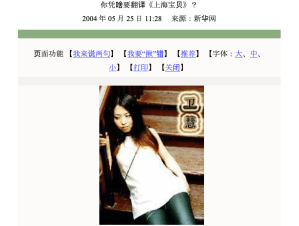
in the UK (if my recollection is correct), penned an essay that ingeniously linked Wei Hui, her novel and my translation of it with the scandalous abuse of Iraqi prisoners by their American captors — perhaps most infamously, by Lynndie England — in Abu Ghraib Prison during 2003-4.
Bordering on fabulism perhaps, but a compelling read, and one which says much about how agitated some people (read: straight Chinese men) were about Wei Hui’s novel.
Below is my translation of that vintage essay. I’ve added a term or two here and there for context’s sake, but done my best to retain its holier-than-thou tone.
Enjoy!
Bruce Humes
Tainan, 2024.3.5
Why the hell did you bother
to translate Shanghai Baby?
By Zhu Pengpeng
(Chinese original published 2004.5.25)
Xú Mùshí (徐穆实) is an American who can speak Beijing-flavored Chinese fluently. His English name is Bruce Humes. He arrived in Taiwan in 1978 to study Mandarin, then in 1982 went to work for a Hong Kong-based American magazine publisher, taking up a post as a copy editor on Global Sources. He worked in Shanghai between 1998 and 1999.

In Humes’ own words, he is “the type of person who is interested in rebellious characters, and cares little for those who inhibit themselves.” In the China of Reform and Opening, when a cohort of our compatriots were seduced by freedom and sex à l’américaine, Humes fit right in, “playing the lovable foreigner, chasing girls, and gorging on Chinese food.”
He is someone who “lives life to the fullest.”
To be frank, I was still unsure what sort of fellow this Humes might be. It was only after reading his bestselling English version of Shanghai Baby that I realized that there is a coterie of Americans, unduly fond of trashy novels from China, who excel at churning out their own trashy renditions.
Shanghai Baby is a 2001 translation of Wei Hui’s novel, 上海宝贝, which was originally published in the year 2000. A semi-autobiographical revelation of a woman’s personal sexual journey —“A tale of love, sex and discovery,” as one promotional blurb had it — the novel fit Humes’ taste perfectly.
The protagonist is a young, beautiful, and uninhibited woman with the additional boost to her reputation of a diploma in Chinese from Shanghai’s Fudan University — the equivalent in our society of a sky’s-the-limit, premium credit card, valid anywhere.
However, lust comes to dominate our main character’s nature, leading her to toss propriety to the wind. The woman’s licentiousness does not violate her dignity but is instead sanctified, elevating her to the unimaginable heights of the latest generation of “New New Human,” the term used to tag young people that put more emphasis on things material and sensual than their predecessors.
Of course, it was because of the novel’s indulgence in these themes that it was banned in China.
It should come as no surprise that this “baby” of Shanghai falls short of Pan Jinlian, the adulteress of the erotic Ming Dynasty classic Plum in the Golden Vase, or the protagonist in A Young Girl’s Heart, the pornographic novel that circulated as samizdat during the Cultural Revolution. We live in a time when, if we type ‘adult video’ into a search engine, we can immediately pull up Americans engaged in bestiality, or witness Japanese carrying out father-daughter, mother-son keep-it-in-the-family incest. By comparison, Shanghai Baby is relatively tame. In the end, the only aspect in which it can be compared to those works is its self-righteous insult to our intelligence.
It should be noted that Humes studied anthropology. This means that he is “interested in human relations, and in observing cultural phenomena and trends in social development.” Wei Hui, on the other hand, studied in the Chinese department, and her interest lies in writing fiction, but, in fact, there is little difference between the two pursuits, since fiction is also about delving into human relations and taking stock of social and cultural goings-on.
Unfortunately, a preoccupation with lust leads people to the same unimaginably ugly places.
We can observe that things in nature are naturally divided by type, and so people are defined by which group they belong to: sophisticated discernment and low-brow taste will unite even those who hail from different hemispheres.
Originally, I was a bit puzzled by the multi-talented Humes’ choice of Shanghai Baby as the subject of a translation. This sort of “baby” doesn’t represent Shanghai and even less so China. The psychological “complex” of the novel is meaningless, and all of the emotion spilled across the pages is surplus.
Finally, I came to a realization. He has made the mistake of equating independence and freedom with licentiousness and shamelessness.
I recall the incident of “prisoner abuse” on the part of the US military in Iraq. It shocked the world to see a lady soldier so brazen as to toy with the reproductive organs of male captives, but this was because male and female soldiers had already engaged in a frenzy of sexual debauchery before the incident.
Fortunately, we learned from American media reports that the relatives of these soldiers back home were incredulous, since, before they went to the Middle East, they were so innocent and kind. How could they have done such revolting things? American elite and public opinion unanimously condemned the “prisoner abuse,” and declared that these obscene and ugly acts did not represent the United States.
Let’s hope not, and I believe that it does not.
And so, it is my wish that Bruce Humes, Wei Hui and all the men and women in the world who have exalted lewdness, might cast aside perversion to return to what is sacred in humanity. I hope that they are capable of leaving behind a modest spiritual legacy, in a proper and honorable manner, for our next generation. [终]
Readers may be interested in a Q & A I did, back in the day, about the process of translating the novel. See Bruce Humes & his Shanghai Baby
(*** To read comments or leave your own, please scroll down)
 Altaic Storytelling