

A while back I stumbled upon a short Chinese news item about a newly discovered handwritten manuscript of the Kyrgyz Epic of Manas (玛纳斯史诗). This centuries-old trilogy in verse recounts the exploits of the legendary hero Manas, and his son and grandson in their struggle to resist external enemies and unite the Kyrgyz people. Along … Continue reading Jusup Mamay, Manaschi: A Rehabilitated Rightist and his Turkic Epic
Category: Altaic Peoples & Tales (阿尔泰各民族及其故事)
Soft Power Strategy: Where Does China Figure in Turkey’s Literary Translation Program?
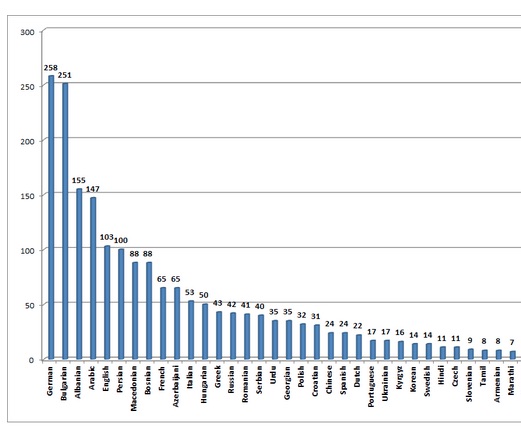
Over the last 11 years, Turkey has spent US$4.4m to fund translation and publication of fiction by Turkish authors via its TEDA grant program, according to Turkish Books, an article that appeared in the Hürriyet Daily on February 24, 2016. TEDA's own chart shows that just 24 titles appeared in Chinese as a result, compared … Continue reading Soft Power Strategy: Where Does China Figure in Turkey’s Literary Translation Program?
List: Modern China-based Evenki Authors & Their Published Works
* Under Construction * Modern China-based Evenki Authors & Their Published Works This list is based mainly on authors published in 2015 in 《新时期中国少数民族文学作品选集·鄂温克族卷》(lit, Selected Fiction by Ethnic Minority Writers in the New Period, Evenki Volume, at left), but I've added in many of their other published short stories and novels. All links are to … Continue reading List: Modern China-based Evenki Authors & Their Published Works
Mapping Mongolian Music
In 蒙古音乐地图计划:如何面对外界错位的蒙古文化想象?Thepaper.cn reports on a young Chinese citizen of Mongolian heritage, Odon Tuya (敖登托雅) who has initiated her own “Mongolian Music Map Project” (蒙古音乐地图计划). Her aim: To document the current indie Mongolian music scene – including traditional musicians in places like Xinjiang – via published interviews and, eventually, to capture it on film. A writer … Continue reading Mapping Mongolian Music
Excerpt: Hong Ke’s Xinjiang novel, “Urho”
Hong Ke's novel, Urho (乌尔禾, 红柯著), is set during the 1960s in the Zungharian Basin at the edge of the Gurbantünggüt Desert. This remote and rugged area of Xinjiang was once a favored hunting ground for the Mongol Khans when they ruled Cathay. A Han soldier back from the Korean front --- dubbed “Hailibu” by … Continue reading Excerpt: Hong Ke’s Xinjiang novel, “Urho”
Fiction Collections from Daur, Evenki and Oroqen Writers Launched
Three separate volumes of fiction in Chinese have just been published featuring the works of writers of three ethnic groups that have traditionally inhabited northeastern China and even further north in Siberia: the Daur, Evenki and Oroqen (Elunchun). This is of interest because unlike ethnic groups like the Tibetans, Uyhgurs or Mongolians, none of the … Continue reading Fiction Collections from Daur, Evenki and Oroqen Writers Launched
Excerpt of the Week: The Nightjar at Dusk (黄昏夜莺)
So now the escapee nightjar and I were conspirators. I had to stay patient and play my part in its plot. We stood a while longer, though of course the urgent call did not sound. But the boy stood there motionless, gazing up at the spot where the bird had once perched. He already had … Continue reading Excerpt of the Week: The Nightjar at Dusk (黄昏夜莺)
Pathlight Spring 2015: A Handful of Pieces by Mongolian and Xinjiang-based Writers
The new issue of Pathlight (Spring 2015) Chinese literature in translation is out. Its theme is Nature, and you can download the PDF for free here.A quick look at the contents reveals four pieces that fall at least loosely into the "ethnic-themed" fiction category:Two pieces by Mongolian writers:Wolves Walk Atwain (p 18) Deng Yiguang (邓一光) … Continue reading Pathlight Spring 2015: A Handful of Pieces by Mongolian and Xinjiang-based Writers
Baidu Encyclopedia First? Uyghur Author’s Name Noted in Uyghur Script
An entry I read today in Baidu Encyclopedia (百度百科), a domestic site which serves as a (politically correct) Wikipedia for mainland Chinese — the latter is often firewalled — may signal a change in the policy of referring to members of minority ethnicities by Chinese name only. Qurbanjan Semet, author/photographer of the recently launched I … Continue reading Baidu Encyclopedia First? Uyghur Author’s Name Noted in Uyghur Script
Kurdish Dengbêjî and the ‘Nostalgia Industry’
Building the dengbêj ‘tradition’ . . . must also be considered in a wider context. Interest in memory is rapidly spreading in contemporary Turkey and is helping people explore personal and collective histories. These memories are also — within certain limits — fostered by official narratives that ‘rediscover,’ for instance, an Ottoman and multicultural past. … Continue reading Kurdish Dengbêjî and the ‘Nostalgia Industry’

