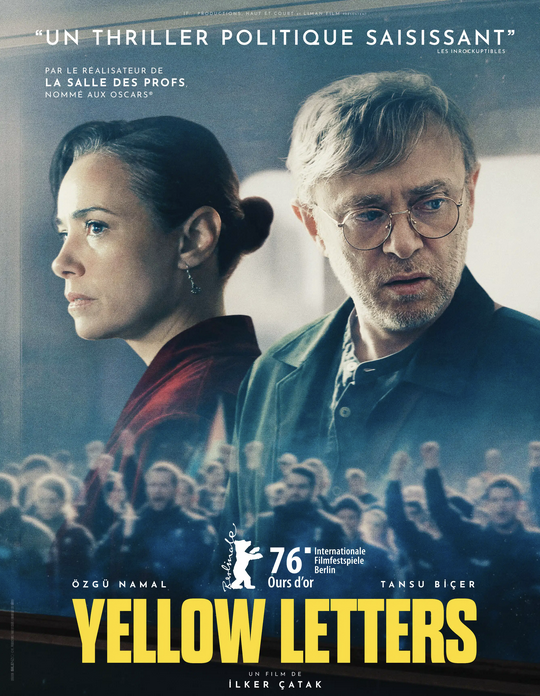

In A New Wave of Defiance, Turkey’s best-known contemporary writer in English – Kaya Genç – reviews two politically outspoken films that examine Erdoğan’s regime, Yellow Letters (Sarı Zarflar) by Ilker Çatak and Salvation (Kurtuluş) by Emin Alper, which won awards at the recent Berlinale film festival:
Since the violent crackdown on the Occupy Gezi protests of 2013, an uncanny hush has dominated the country’s cultural sector. Çatak and Alper’s new films depict living in such an autocracy in strikingly original and historically resonant ways.
Aziz (Tansu Biçer), a university professor and dramatist, is fired after advising his students to participate in anti-war protests outside the university. He is, after all, teaching Brecht’s alienation effect that week, but a student informs on his call to attend “the great rehearsal of public politics”. Aziz learns his fate in a yellow envelope: he’s accused of disseminating terrorist propaganda and incitement to violence, and becomes persona non grata overnight. His wife, Derya (Özgü Namal), a successful actor, is purged from the state theatre soon after. Rectors and theatre directors quickly comply with whatever the state says about their employees. Even the couple’s landlord is unforgiving. After a telling-off from the police, he says he can no longer house them.
Derya and Aziz, the couple at the heart of Yellow Letters, are victims of Erdoğan’s purges. More than 1,000 academics were condemned to “civil death” after signing a peace petition in 2016. Charged with “spreading propaganda for a terrorist organization,” the self-styled Academics for Peace lost their civil rights and livelihoods; esteemed professors started new lives by taking on manual work, driving cabs, pumping oil at gas stations, and going into exile in various European countries, including Germany, where Yellow Letters was shot.

