
Translating Taiwan: Meetings with Literary Translators features interviews with several translators — including into English, French, Japanese and German — and identifies one unique focus:
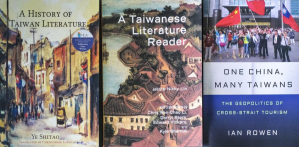 In terms of subject matter, gender is a popular theme among Taiwanese writers of all ages. This shared commitment reflects Taiwan’s persistent struggles for gender equality over the decades, as well as being the first Asian country to legalize same-sex marriage. Noriko Shirouzu, professor emerita at Yokohama National University, is known in Taiwan for having translated Gan Yao-Ming’s novels into Japanese. A veteran scholar of feminist and LGTB issues, she observes that Taiwanese literature abounds with works that give pride of place to women and queer subjects. Prominent examples include Pai Hsien-yung’s Crystal Boys (1983) and Taipei People (1971), Li Ang’s The Butcher’s Wife (1983), Qiu Miaojin’s Notes of a Crocodile (1994), Chi Ta-wei’s Membrane (1996), and Kevin Chen’s The Good People Upstairs (2022).
全文在此.
(*** To view previous posts or leave your own, pls scroll downward)
 Altaic Storytelling
Dylan Levi King, freelance writer and translator based in Tokyo, made this comment, but some reason, my blog didn’t record it. So I’ve copied it in full as below:
I notice that the writer that I now would trumpet as the best contemporary Chinese writer, Chu T’ien-wen 朱天文, regrettably doesn’t get a mention.
Pai Hsien-yung 白先勇 is there, though. Last year I went back and read and re-read the bulk of his work, going through the originals, as well as the translations, some of which he also worked on. He goes on my short list of genuinely brilliant contemporary Chinese writers.
It’s interesting to think about why Taiwan produced so many great writers. One factor is the Communist Party’s victory in the civil war driving a number of intellectuals out of the country, and the perspectives of those people, which was, especially after arriving in Taiwan conservative and nostalgic, fixated on the lost Cultural China. But I think some credit has to go to the United States Information Service for driving Taiwan literature in a healthier direction, and financing literary modernism through support for writers and journals.
The Americans were very clever! There’s a reason they won the Cultural Cold War.
In the struggle against the ideology of collectivism, they knew that anti-communist writing was hopelessly lame, and, even worse, was completely useless. They chose instead to fund great artists, including people like Pai Hsien-yung. The greatest blow that could be struck against communism would be delivered by highly individualistic, artistically-advanced, modernist literature, rather than dour anti-communism. (Against the conservative, aesthetically-inclined literature of the time, literary modernism and the avant-garde could paradoxically be the voice of the people, or at least the younger generation.)
A gentleman named Richard McCarthy is remembered for heading up what Mei-hsiang Wang 王梅香 calls the “U.S. aid literary institution” 美援文艺体制. He was the type of diplomat-spook that I fear doesn’t really exist anymore: he was as comfortable mixing with artists as bureaucrats, he spoke multiple languages, he adored poetry… He is sometimes given credit for discovering Eileen Chang 张爱玲, which is misleading, but he is certainly the first Westerner to put her on a salary, and he shaped the second half of her career.
His work in Taiwan was brief but transformative. That is what Pai says, it’s what Ouyang Tzu 欧阳子 says… McCarthy helped to save Modern Literature 现代文学, which both writers worked on, and which provided the seed from which contemporary Taiwanese literature grew. The journal published Taiwanese writers (fiction and poetry), established authors from around the Sinosphere, as well as translations of Faulkner, Joyce, John Dos Passos…
A few years back, maybe as part of a documentary, maybe when Xianwen yinyuan 现文因缘 came out, which tells the history of the journal, these writers revealed the fact that the roots of Modern Literature were watered by what was essentially CIA money—and it was met with some controversy… Pai trumpeting the contributions of McCarthy was more controversial in a time when American intelligence community contributions to the arts were not quite as popular.
Of course, the Americans aren’t the whole story. Their contributions were limited and only temporary. They failed to support a number of worthy writers from outside a particular avant-garde establishment, as well as more aggressively political writers. But we can agree that they planted the seeds of literary modernism in Taiwan, which is important.
So, the continued existence of highly personal, avant-garde fiction from Taiwan can be traced in part to the CIA!
LikeLike
My apologies! Seems no one is able to leave comments on my blog at the moment. Will try to sort this out soonest. In the meantime, feel free to email your comments to me, and I will input for you.
Here is the latest from frequent visitor, Bathrobe:
A very interesting read. One thing that has always struck me is the outsized representation of Taiwanese translators in translating foreign literature into Chinese. Many Taiwanese translations are reproduced by Mainland publishers (under licence, one would hope), suggesting that Taiwanese translators have had a larger influence on the reception of foreign literature in China than the size of their “province” would suggest.
LikeLike