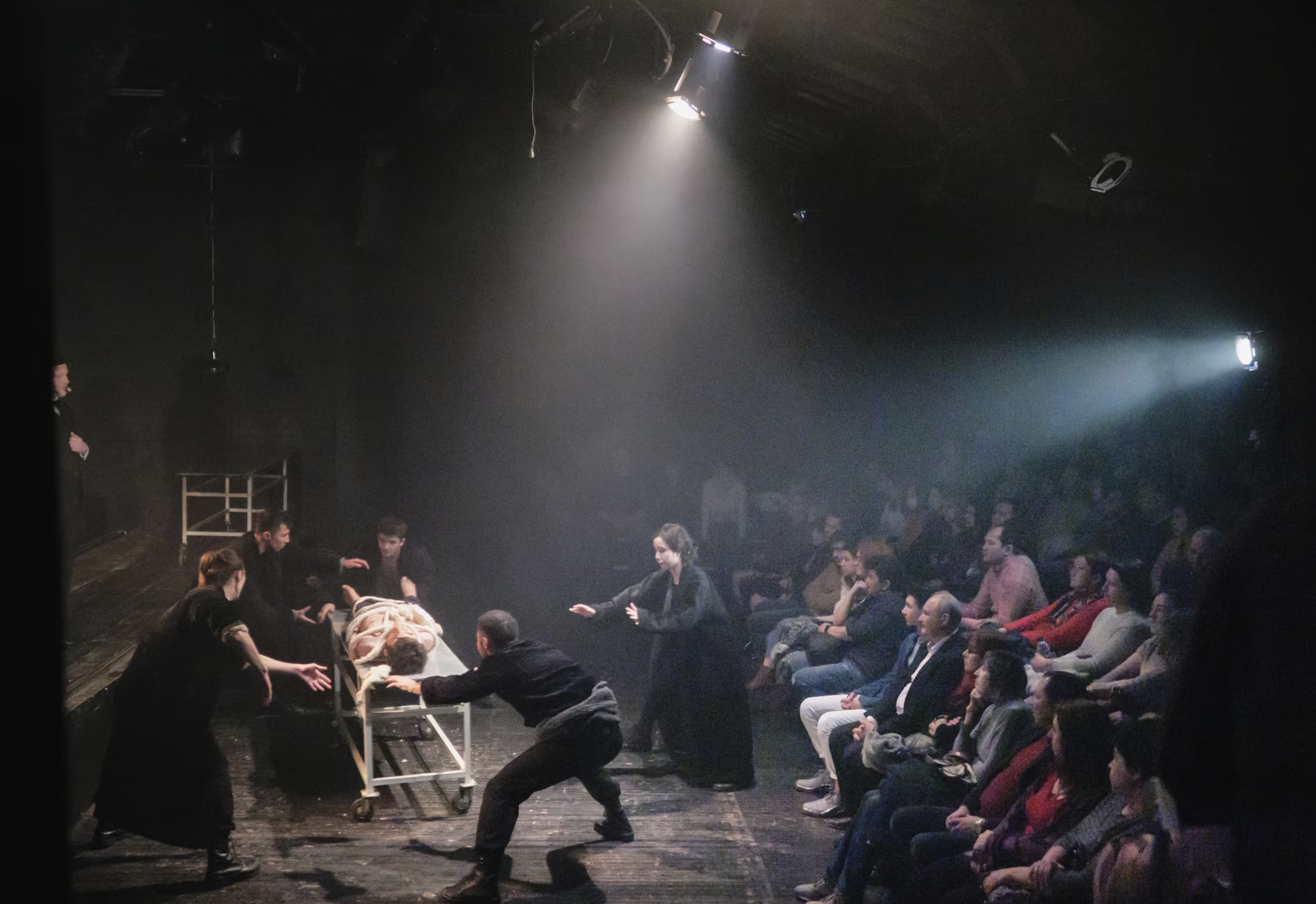

We supported Mark Weil and his troupe [at Ilkhom Theatre]; we provided them a wonderful venue. However, as paradoxical as it may sound, Mark Weil even told us that we know nothing about the art and our role is restricted to simply financing their productions. We are very patient with the studio members and we hope that the situation will get better over time.”
(Komsomol official cited in 1980 essay by Moscow art critic Yuri Galkin)
Thanks to a visionary director – the son of Ukrainian Jews – the Soviet cultural authorities’ desire to attract its youth with more contemporary and relevant art, and Moscow’s perception of Central Asia as a cultural backwater not worthy of micromanagement, in 1976 an experimental theater was quietly born in Uzbekistan’s Tashkent.
The latest episode of Turan Tales podcast, Ilkhom: The Boldest Theater in Central Asia, features an interview with Irina Bharat, Director of International Programs at Ilkhom, the only independent theater in post-Soviet Uzbekistan. Host Agnieszka Pikulicka covers much of the history of the controversial venue with Bharat, including her memory of the shocking murder of the troupe’s founder, Mark Weil, in 2007.
Another source of insight into the theater is an essay by Zukhra Kasimova, Ilkhom as a Hybrid Phenomenon, in which she writes:
The hybridity of Ilkhom was palpable not only in the choice of repertoire — from Russian new wave theater plays to Uzbek dramaturgy — but also in the studio’s multiethnic troupes and bilingual performances.
How much of this innovation was inspired by the Zeitgeist (which included perestroika), the relatively hands-off attitude of the cultural authorities, and how much was due to Weil himself and his upbringing, is not perfectly clear.
As the essay notes, Weil was (unintentionally) blessed with a bit of bureaucratic ambiguity. Ilkhom operated “under the aegis of both the Central Committee of Youth of Uzbekistan (a Republic level Komsomol organization) and the Youth Section of the Theatre Society of Uzbekistan,” notes Kasimova. It appears that the Weil managed to make the most of this confusion to do his own thing.
While not Muslim himself, Weil operated the Ilkhom Theatre in predominantly Muslim Uzbekistan, where he staged provocative and socially critical works — including a production called Imitations of the Koran. His murder was tied by investigators and trial testimony to religious extremists reacting to his artistic depictions of Islamic themes.
*** If you’d like to view comments or leave one of your own, please scroll down. It may not appear immediately, as my system requires that I “approve” it. If you’d like your name to appear, add at the end, otherwise it will likely be labeled “anonymous.” Critical comments are welcome; just keep it polite.

