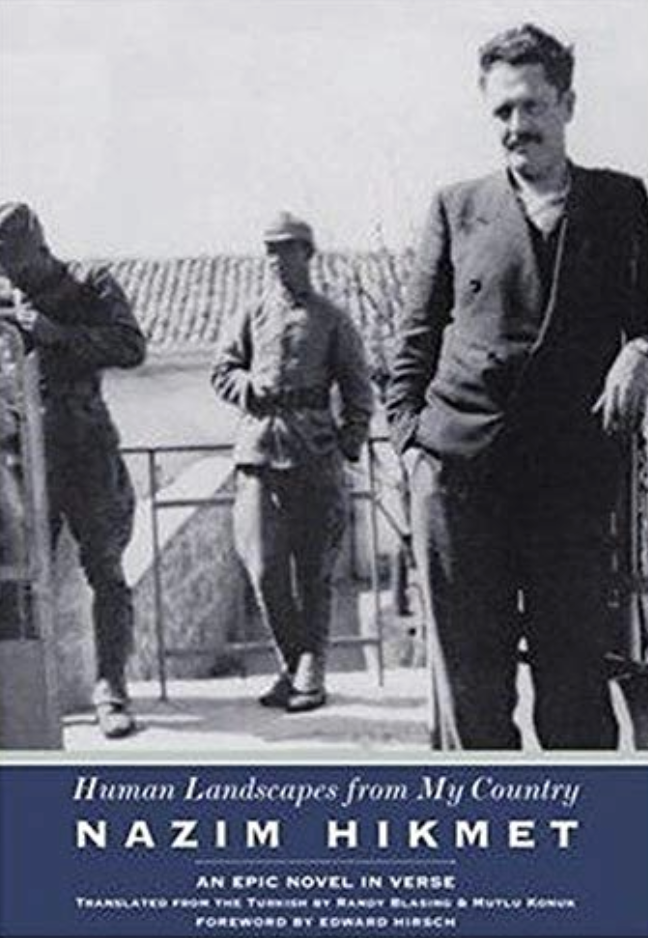

I’ve ignored the Introduction’s irksome description of Nâzım Hikmet as a “necessary poet of the twentieth century,” and gone on to read the translator’s more enlightening Foreword to the Turkish poet’s Human Landscapes:
. . . there is a sense in which the poem is literally a cooperative venture, for the prisoners Hikmet knew provided not only the characters for his poem but the audience and criticism that helped shape it. As he wrote his epic, Hikmet would read it to his fellow inmates, and any phrasing, diction, or episode that did not ring true to them was immediately revised. Thus Landscapes is the joint fiction of novelist and poet, social historian, folklorist, and dramatist, author, characters, and audience, and it presents life itself as a joint human creation. This is the meaning of the inclusiveness of the epic genre, and this is ultimately the only political ‘message’ of Landscapes: human beings have the power to make and change human life.
(Foreword to Human Landscapes by translator Mutlu Konuk)
*** If you’d like to view comments or leave one of your own, please scroll down. It may not appear immediately, as my system requires that I “approve” it. If you’d like your name to appear, add at the end, otherwise it will likely be labeled “anonymous.” Critical comments are welcome; just keep it polite.
*** If you’d like to view comments or leave one of your own, please scroll down. It may not appear immediately, as my system requires that I “approve” it. If you’d like your name to appear, add at the end, otherwise it will likely be labeled “anonymous.” Critical comments are welcome; just keep it polite.

