
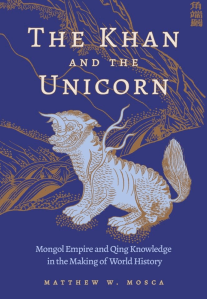
In this review of the newly published The Khan and the Unicorn: Mongol Empire and Qing Knowledge in the Making of World History, David Chaffetz points out shortcomings of both Chinese and Europeans regarding Mongol history:
Chinese historians seeking to understand the life of Genghis Khan faced a number of obstacles, even though his Yuan dynasty ruled China for a century and the succeeding Ming dynasty authored an official history. The transcription of non‑Chinese names of people and places, as well as limited familiarity with the geography of Inner Asia, resulted in garbled and contradictory accounts of the khan’s extensive conquests. Even today, it can be difficult to follow his campaigns across Inner Asia, Iran, and India, so one can sympathize with Chinese scholars working without maps. Chinese accounts also suffered from an ideology that considered the grassland peoples inherently cruel and rapacious. Bias against the Mongols could be subtle: names transliterated using derogatory characters, or recording a ruler’s passing with the simple word “die” 死 instead of the respectful “expire” 崩.
Europeans, on the other hand, gained considerable insight into the Mongols by translating key Persian and Arabic historical texts. Compared to the fraught politics, less efficient printing, linguistic complexity, and bureaucratic obstacles faced by their Chinese counterparts, 18th century scholars like Pétis de La Croix and Joseph de Guignes enjoyed relatively smooth sailing. But both Europeans and Chinese suffered from an inability to understand the Mongols on their own terms. Both sides of the Eurasian continent saw Genghis Khan as a barbarian, and the Mongol conquests of the civilized realms of Iran and China as a historical tragedy.
*** If you’d like to view comments or leave one of your own, please scroll down. It may not appear immediately, as my system requires that I “approve” it. If you’d like your name to appear, add at the end, otherwise it will likely be labeled “anonymous.” Critical comments are welcome; just keep it polite.
 Altaic Storytelling