
In August 1994, not long after I’d returned to Lanyu to learn to dive and to take care of my parents, who adhered to the old modes of thought, and my children, who thought in Chinese, I went on a junket to faraway Hsinchiang Province with the Indigenous scholar Sun Ta-chuan, the Indigenous writer Topas Tamapima, a Manchu scholar, and a female Taiwan-born Uyghur writer. The Uyghur homeland had surfaced as a place I wanted to visit in the ocean of my mind way back when I was a prep school student on Nanyang Street.
In my history textbooks, which were mandated by the Kuomintang (KMT), the savages of that land were called the Northern Ti, while in my high school imagination, China’s northwest was home to tribes of fierce and brave peoples who ran circles around the Han, who couldn’t tell which way was up. The Hsiungnu, the Turks, the Mongols, and the Jurchen were names to reckon with. These beautiful peoples were barbarians in Han historiography, just as “untamed” peoples were called primitives in the white man’s ideology, out of the same kind of unreflective arrogance. At that time, I thought that only the Han Chinese were civilized. That was what I had learned from the schoolteachers who had taught us “primitives” and “barbarians” on Lanyu from 1953 to 1970.
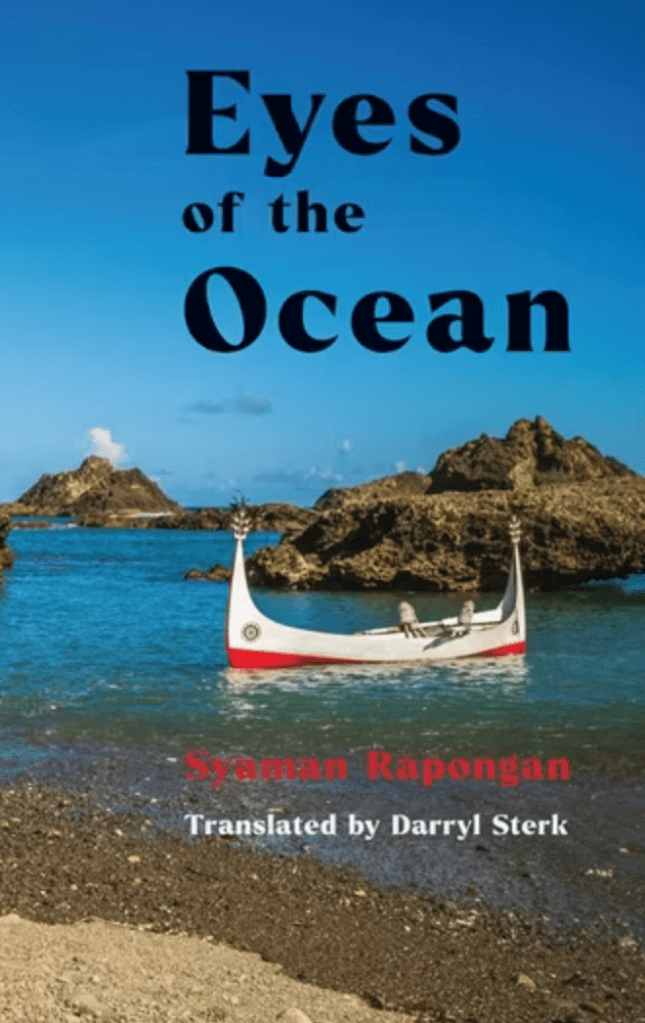
(Excerpted from Eyes of the Ocean by Syaman Rapongan, a Tao (native of Lanyu Island off the southeastern coast of Taiwan), as translated by Derryl Sterk)
***To leave a comment or read those by others, pls scroll down. Don’t be surprised if your comment does not appear immediately; unfortunately, the system requires that I approve it first. It may also identify you as “anonymous,” so if you want your name to be visible, best add it at the end of your comment.
 Altaic Storytelling