
An interesting interview over at China Digital Times (CDT), Gerald Roche on the Erasure of Tibet’s Minority Languages, explores the linguistic map of Tibetan-speaking regions in China. Roche is an anthropologist and Associate Professor in the Department of Politics, Media, and Philosophy at La Trobe University, Melbourne, Australia.
Much of it is about his research into speakers of Manegacha, which is a Mongolic, not a Sino-Tibetan language, and thus qualifies as one of 30 or so “minority languages” in Amdo (Qinghai). Speakers in Amdo tend to be Buddhist and consider themselves Tibetan, but the Bonan of Gansu, who practice Islam, also speak Manegacha.
An excerpt from the Q & A:
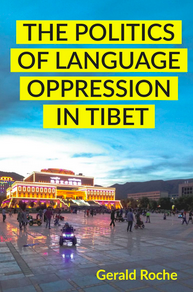
CDT: In addition to these pressures that you’re talking about, you also say that the Manegacha speakers face more explicit discrimination, specifically they face what you call “banal violence.” Could you explain what you mean by that and what you saw when you were there?
Roche: Banal in one sense just means everyday, like taken for granted and accepted, and this was very much the nature of the violence against Manegacha speakers. I did interviews with Manegacha speakers about the discrimination that they face, and I also worked with a research assistant who went and spoke to Tibetan speakers about the discrimination that they enact against Manegacha speakers. And I thought those second interviews would be kind of difficult, and people would not want to say very much about it, but local Tibetans were just like, “yeah, this is what we do. We think that they are not really Tibetan. We think that they need to use Tibetan better. We think that they are maybe traitors to the Tibetan cause,” and so on. So people were just very unashamed of the way in which they discriminate against Manegacha speakers. So if you’re a Manegacha speaker in Rebgong, the main problem that you face in relation to language is that everyday discrimination from other Tibetans. Other Tibetans will dehumanize Manegacha speakers—they will compare them to animals or say that they are not really human in the same way as Tibetan speakers. They will describe Manegacha [language] by comparing it to animal noises, so that they will call it bird talk or compare it to the sound of frying beans–it’s not really language. It’s just noise.
(To comment or read others’ comments, scroll down)
 Ethnic ChinaLit
Bruce,
Fascinating. And depressing.
I was unaware of the scale of multiplicity of languages in Tibet though I have long been familiar with the one “minority”/one language policy that has long prevailed. (The article makes no mention of the latest broadside on languages: particularly but not exclusively in Inner Mongolia has been the attack on teaching and use of Mongol language even for the Mongol population which, unlike Tibet, the titular minority population is a small fraction of the total population, perhaps 12 percent when I last saw a figure.)
What about Inner Mongolia, the subject of our book, A Chinese Rebel Beyond the Great Wall. The Cultural Revolution and Ethnic Pogrom in Inner Mongolia, With TJ Cheng and Uradyn E. Bulag?
Inner Mongolia has recently been the focus of regime crackdown on minority languages … teaching, speaking, reading. But the literature I’ve seen has centered on the Mongol language. The Tibet story alerts me to the likelihood that there may be a variety of other languages spoken in Inner Mongolia as in Tibet. Particularly interesting if some of those are languages spoken by and taught to Mongols, but also those by people of other nationalities.
All best in the New Year.
Mark Selden
Founding Editor, The Asia-Pacific Journal: http://apjjf.orghttp://apjjf.org/
Homepagehttp://www.markselden.info/
Dying for an iPhone: Apple, Foxconn and the Lives of China’s Workershttps://www.haymarketbooks.org/books/1468-dying-for-an-iphone.
Haymarket Books 2020. Choice Academic Selection 2022.
A Chinese Rebel Beyond the Great Wall: The Cultural Revolution and
Ethnic Pogrom in Inner Mongolia. University of Chicago Press 2023.
LikeLike