
By H K Chang
Translated by Bruce Humes
in collaboration with the author
Now available for purchase online
Miniature Painting Guide:
My Name Is Red
In the summer of 2003, I accidentally came into possession of an English translation of Benim Adım Kırmızı (My Name is Red), a novel by the Turkish novelist Orhan Pamuk. Right from the start I could hardly let go of it. But the plot twists and turns, and a book-length tale revolving around a group of court appointed miniature painters, like a miniature itself, requires a close read for fuller comprehension.
After reading the novel, I deeply admired the author. Six months later, thanks to a friend’s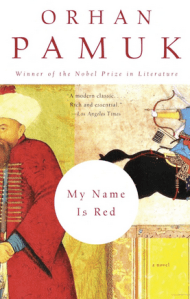 introduction, I went to Istanbul to meet Orhan Pamuk. Our chat went very well, so I invited him to give a lecture at the City University of Hong Kong, and to be the special guest at a “City Cultural Salon” held monthly at my home.
Orhan Pamuk studied architecture, but as fate would have it he became a novelist, not an architect. In order to write My Name is Red, he spent years in libraries researching background materials for this murder mystery set in late 16th-century Istanbul. I was very pleased that two years after his Hong Kong visit, he won the Nobel Prize for Literature in 2006, the first-ever Turkophone writer to be so honored. When the award was announced, I just happened to be in Istanbul and even met his sister-in-law!
My Name is Red is indeed an intriguing novel. But for me personally, its value also lies in the multi-dimensional, in-depth introduction the author provides to the painting of miniatures; the novel itself resembles a muraqqa, an album of Islamic miniatures and calligraphy. While weaving his tale, the author subtly reveals his profound views on several questions.
The clash between Persian miniatures and Italian Renaissance paintings triggers a bizarre murder, which drives the main axis of the novel.
Let’s start with European painting and its genesis in the Renaissance jump-started by the Italians. First of all, the artist selects his own location before painting the scene that he observes. Distance vis-à-vis the painter is defined by relative size, demonstrating the concept of three-dimensional perspective. People or objects are distinguished by nuances of color and light, and day and night are completely distinct, which conveys light and shadow perspectives. During the Renaissance, Europeans began to pursue humanism, and drawing the world as seen by the human eye is itself a manifestation of humanism.
The principles and methods of classical Chinese literati painting since the Tang and Song Dynasties (7-13th centuries), however, are distinct from those in Europe inspired by the Renaissance. Within the same tableau, the painter could observe from various locations the person and scenes he wished to paint. This multi-point perspective, as opposed to fixed-point, means that artistic conception trumps realistic portraiture.
Within the same painting, the artist can switch suddenly from looking up at a mountain to gazing down from its summit. The person or object to be highlighted can be portrayed quite large, and objects that serve as a foil need not be conveyed proportionally.
But the Chinese painter nonetheless had certain rules to follow: Nighttime must be dark and daytime bright, flora gaily colored, mountains and trees portrayed with peculiarity, and so on.
Miniatures were all illustrations for a book and placed adjacent to the related text. The topic of the miniature could be found in those words, so the illustration was simply the graphic expression of a given scene in the tale. This format represented a challenge to the miniaturist in that his depiction was juxtaposed with the text it sought to interpret, and also provided a limited space for its creative expression.
Since many of the classics destined for illustration expressed Sufi inspire illusory experience, the artists accordingly depicted them from a Sufist “combined human and divine” angle. The fundamental argument of the miniaturist was that the human eye cannot detect reality; what it “sees” is an illusion. Therefore, they did not use what the human eye perceived as their benchmark for illustration. All the matter that populates our universe, animate and inanimate, is Allah’s creation and is constantly visible to Him. The view of the human eye might be blocked, but this did not alter the fact that beyond those mountains and walls lay other people or objects.
The miniaturist believed that since Allah created the world thusly, it was entirely permissible to depict the world behind those walls. Additionally, the key personages in the text were naturally depicted larger similarly to Chinese-style painting. Illustration was not limited to reality as perceived by the human eye, and this is the first characteristic of the Persian miniature.
The miniaturist’s use of light, however, was distinct from that of Chinese or European painters. The Persians preferred strong primary colors, avoiding intermediate tints, resulting in very bright illustrations. To this end, a steed could be blue or red. Of course, daylight action required a bright background, and to indicate nighttime, the moon would be visible in the sky. This was the second characteristic of the Persian miniature.
The main characteristic of miniature illustrations is detail, a painting technique that is hard on the eyes, leading to a loss of vision for some in old age. This is portrayed in Pamuk’s novel, in which an elderly illustrator can continue to work even after he goes blind, because he distinctly recalls how each detail is conveyed via his brushstrokes. In other words, miniature painting is a stylized, conceptual art, a bit like the face masks employed in Peking Opera. When it came to people, each had a certain look; there were stereotypes for painting a horse too.
The reason is that, for one, in Islamic culture there was little traditional emphasis on the depiction of people or animals; a horse is a horse, a conceptualized horse, not a specific horse. As intriguingly argued in China by Master Gongsun Long (公孙龙) three centuries before Jesus, specifically defining a given horse as “white” implied that a yellow or black one was not a horse, so strictly speaking, there was no such thing as a “white horse” — 白马非马! It didn’t matter what the characters in the story looked like — since no one had actually seen them — so stylized faces did not pose a problem.
Orthodox Islamic scholars were not in favor of drawing the human figure, so for artists, it was not only easier to avoid doing so in their miniatures, but it had the advantage of lessening critical voices and increasing legitimacy in terms of Islamic doctrine. So, stylization was the third characteristic of miniature painting.
From the development of Persian poetry and painting, we can see that the evolution of culture was closely related to Persian society’s interaction with the outside world. Both poetry and painting were externally influenced, but the Persians nonetheless created unique modes of verse and illustration originating primarily in their own cultural roots.
Although miniatures were dominated by Sufists, in the Persian cultural circles of the 14-16th centuries, the overall style remained roughly similar regardless of the painter’s personal faith; there were no “anti-Sufi” or “non-Sufi” schools of painting as such.
During the period of Mongol rule, the Buddhist art of Dunhuang murals (敦煌壁画) entered the Persian consciousness, and Chinese-style twisted tree roots, wispy clouds, mythical unicorns, dragons and phoenixes began popping up in 14-15th-century miniatures. The master miniaturist Kamaleddin Behzad (1450–1531) is believed to have executed a famous illustration, Prophet Muhammad’s Ascension, included in Seven Thrones, the famous poetry anthology. He introduced the concept of Buddhism into this miniature, and even the figurative representations therein were drawn upon Chinese Buddhist paintings.
Persian culture possesses its own profound heritage but has also been capable of continuously integrating foreign elements. Therefore, it has repeatedly rejuvenated itself and created a dynamic culture that is at once “refreshingly new yet ancient.”
(***To read previous comments or add your own, please scroll down)
 Altaic Storytelling