
Welcome to the blog that I launched more than a decade ago, and have hosted since. Granted, it has undergone a number of iterations — initially Ethnic ChinaLit: Writing by & about non-Han Peoples, then 非漂 [Fēi Piāo], Altaic Storytelling, AfroLit4China, and most recently Ethnic ChinaLit again — but 300+ posts dating from 2009 to present can still be found here.
I’ve just finished co-translating <凿空>(working title: The Audible Annals of Abudan), a novel by Liu Liangcheng (刘亮程). A Han native to Xinjiang nicknamed the “bucolic philosopher,” he won the prestigious 2023 Mao Dun Literary Prize for his <本巴>, a tale inspired by Jangar, the famed Mongol oral epic, and his One Man’s Village (一个人的村庄) has sold well over 1m copies in China. Audible Annals is set during the early 2000s in a southern Xinjiang village populated by farmers with Turkic-flavored Muslim names, their donkeys whose collective braying engenders a “mass incident,” and motorized vehicles that presage disruptive change. Co-translator Jun Liu and I have drafted a complete marketing kit to help foreign language rights holder Yilin Publishing market the translation to publishers outside China.
During 2024, two of my book-length, Chinese-to-English translations were published: Daughter of Dunhuang: Memoir of a Mogao Grottoes Researcher <我心归处是敦煌>, true saga 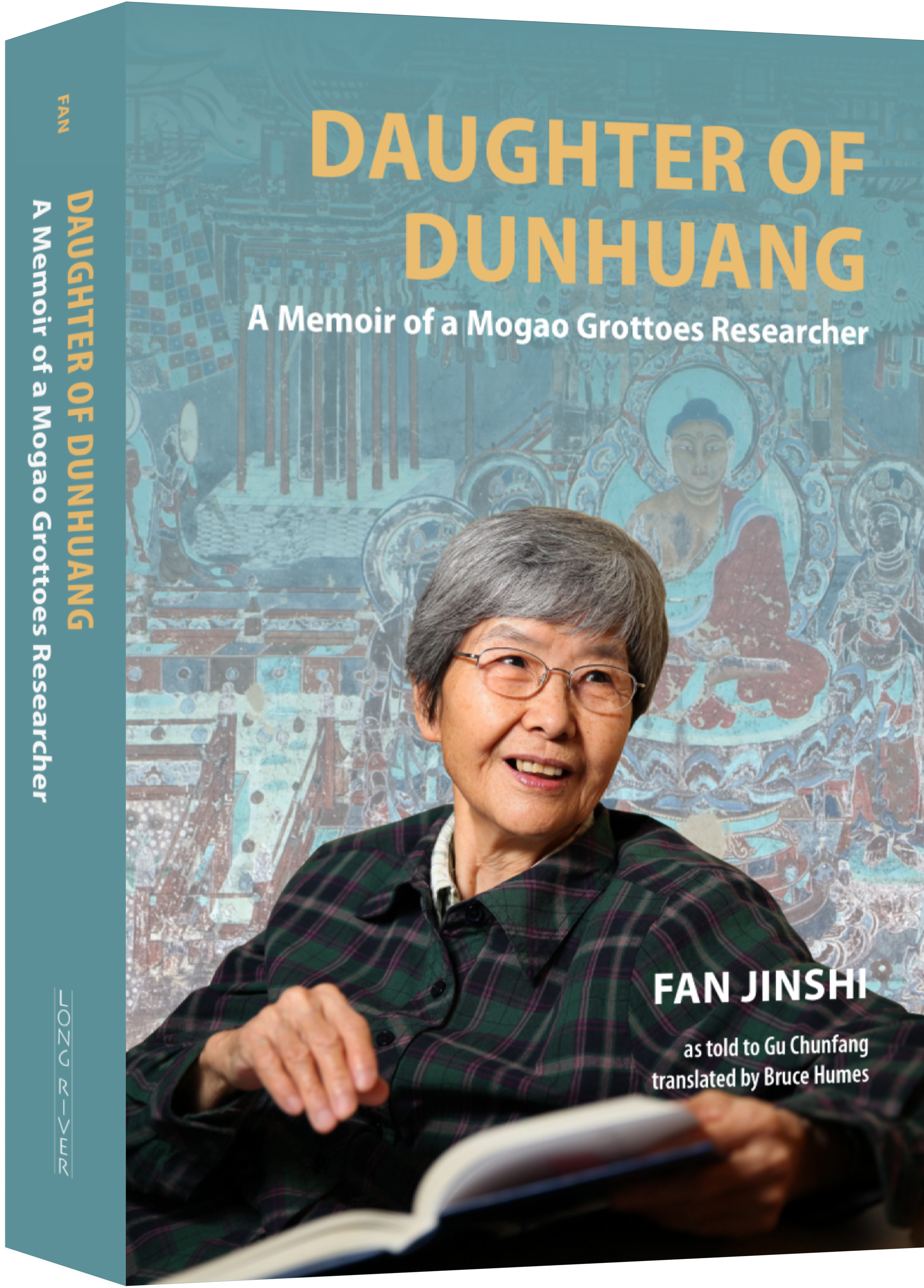 of the tenacious female archaeologist, Fan Jinshi (樊锦诗), who devoted her career to the documentation, restoration and preservation of the Buddhist-themed Mogao Caves in Dunhuang; and Professor H.K. Chang’s Mapping Civilizations across Eurasia <文明地图>. Topics include Tracing the Footsteps and Influence of Xuanzang and Ibn Battuta; Persian Civilization & Iran’s Modernization; Musical Chairs in the Caucasus; Orientology; From Movable Type to the World Wide Web; Westward Migration of the Turkophone Peoples; Islam & the Invaders; The Ancient Silk Road: “Geography as Destiny”; and Frankincense, Oil and Geopolitics.
I will be gradually adding detail to this page, but in the meantime if you want to contact me, please click here.
Like to learn more about my published literary translations — including full-length books and magazine articles — as well as synopses and excerpts for marketing use? Click here.
My (serendipitous) Timeline
2026
- Scheduled re-launch (1Q 2026): My rendition of Last Quarter of the Moon (额尔古纳河右岸), first published in 2013, this time by indie publisher Milkweed Editions. My name will feature on the cover!
- Scheduled launch (1Q 2026) : My translation of the first volume in H. K. Chang’s trilogy, Roaming the Steppe Silk Road (漫游草原丝路) to be published by City of Hong Kong University Press.
- I’ve started translating Moŋgoliya (蒙古里亚) by Guo Xuebo (郭雪波), a contemporary novel set in Inner Mongolia. Visit here for the Synopsis, or here for an excerpt.
2025
- Co-translation complete: Novel by Liu Liangcheng set in Xinjiang, <凿空> (see above)
- Translation underway: Volume 2 of H. K. Chang’s three-part travelogue, Roaming the Oasis Silk Road (漫游绿洲丝路).
- For now, my on-again off-again Turkish studies are . . . on the back burner. Have taken up Japanese again, in the hopes of one day appreciating Edo Period (1603-1868) arts — ukiyo-e, kabuki, haiku and fiction — via Nihongo.
2024
- Published: My translation of archaeologist Fan Jinshi’s memoir, Daughter of Dunhuang
- Draft completed: My translation of the first volume in H. K. Chang’s trilogy, Roaming the Steppe Silk Road (漫游草原丝路) . . . a travelogue now in search of a publisher.
2023
- Published: My translation of Professor H.K. Chang’s <丝路文明: 15 讲> (Civilizations on the Silk Road). Topics include Zhang Qian Pioneers Exploration of the ‘Western Regions’; Kumarajiva Supervises Translation of the Buddhist Canon; Sogdians on the Silk Road; Paper-making Know-how Migrates West; Islam’s Debut in the Middle Kingdom; Rise of the Turkophone Tujüe; and Maritime and Land-based Communications under the Mongols.
2022
- Re-launched: My rendition of Last Quarter of the Moon (额尔古纳河右岸), Chi Zijian’s account of the tragic 20th-century twilight of the reindeer-herding Evenki in the Greater Khingan Mountains of Inner Mongolia and Heilongjiang. This time as one of a collection of 8 “eco-fiction” novels from Penguin, Vintage Earth, that includes Ian McEwan’s Solar.
2020-21
- My tourist visa mercifully extended to the official limit of 180 days, I leave Corona Era Paradise — Taiwan, which has seen just 7 deaths — for Erdoğanistan, oops, Türkiye. At that time in 3Q 2020, to attract tourists neither Corona test results nor quarantine were required upon entry. After a month or so in Istanbul’s Beyoğlu, I move to a tranquil tiny seaside town on the Aegean, and get down to the work that pays the rent: Translating the autobiography of female archaeologist Fan Jinshi <我心归处是敦煌> (excerpt), who devoted 50+ years to the preservation and documentation of the Buddhist-themed Mogao Caves at Dunhuang, and . . . my on-again-off-again Turkish studies.
2018
- Instead of my customary visa run — Tainan-Penang (台南 – 槟郎屿) or Tainan-Kuching (台南 -古晋) — I opt instead to check out Dar es Salaam (坦桑尼亚的达累斯萨拉姆) in East Africa. Very hospitable, the Tanzanians, and I enjoy my brief study of Swahili, a Bantu language that is a national tongue in DRC, Kenya, South Sudan, Tanzania and Uganda. My choice of a tutor from Kenya, however, brings wry smiles to the face of many a Dar es Salaamite, doubtless due to this adage: Swahili was born in Zanzibar, grew up in Tanzania, fell sick in Kenya, died in Uganda and was buried in Congo.
2013-14
- Since the authorities have made learning Uyghur in its spiritual homeland (Xinjiang’s Kashgar, 喀什) impossible, I study elementary Turkish in Istanbul. Both Turkic tongues, Uyghur and Turkish share similar sentence structure and vocabulary. Useful in translating Uyghur author Alat Asem’s Confessions of a Jade Lord.
2013
- Published: My rendition of Last Quarter of the Moon (额尔古纳河右岸), Chi Zijian’s account of the 20th-century tragic twilight of the reindeer-herding Evenki in the Greater Khingan Mountains of Inner Mongolia and Heilongjiang.
2004-12
- Host one-day, intensive export management training sessions in as many as 8 cities monthly in China, and eventually train 8,000+ export professionals how to prioritize incoming queries, maximize earnings from existing clients, and exhibit overseas. At times, a blurry string of cookie-cutter airports and business hotels leave me wondering which city I might be in, but I quickly ascertain my approximate location in the People’s Paradise when the first handful of eager attendees pipe up in their dialect-mangled Mandarin.
2001
- Robbed by a knife-wielding thug in Shenzhen, I awake in a hospital hallway — now People’s Hospital Number 2 — where staff advise amputating my right hand. Immediately. I decline, protesting that I intend to keep it for future use. Check out One of the People (遭遇深圳) for the saga.
2000
- Browsing in 季风书店 bookstore at Shanghai’s Shaanxi Subway Station entrance, I buy a copy of 上海宝贝 (Shanghai Baby) featuring cover selfie of Wei Hui’s sultry lips. My rendition becomes a best-seller in Hong Kong and Singapore.
1992
- Supervise English-to-Chinese translation of 世界经人理文摘 (World Executive’s Digest) — now a popular online portal — China’s first monthly management magazine not targeting lobotomized party cadres.
1978
- Arrive in Taipei all hyped up about my China adventure, only to discover that Ilha Formosa ain’t exactly the People’s Republic. But it is under martial law, it is a one-party state, and several famous dissident writers are in prison.
1969
- Mum, who learned Russian and German to earn her PhD in French lit, teaches me elementary Deutsch that summer using 1st-year university textbook. My first reads not long after: Hesse’s Siddhartha and excerpts from Lutherbibel.
 Altaic Storytelling